First Edition Beginner Books
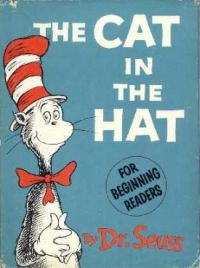 Up until the mid-1950s, there was a degree of separation
between illustrated educational books and illustrated picturebooks. That all changed,
dramatically and with much national fanfare, with the 1957 publication of Dr. Seuss's
The Cat In The Hat (Random House). Here was an early reader,
full of 220 madly rhyming words, which made its way into our elementary school classrooms.
Up until the mid-1950s, there was a degree of separation
between illustrated educational books and illustrated picturebooks. That all changed,
dramatically and with much national fanfare, with the 1957 publication of Dr. Seuss's
The Cat In The Hat (Random House). Here was an early reader,
full of 220 madly rhyming words, which made its way into our elementary school classrooms.
The Cat In The Hat is a tremendously important book. Not just an important picturebook or an important children's book, but an important book without any qualifiers! The publication of the book in 1957 forever changed the way in which children would learn to read and be educated. Reading COULD be fun!
The following table is an excerpt from the Children's Picturebook Price Guide. The estimated values are for first edition books, with dust jackets. The Children's Picturebook Price Guide explains in understandable terms the methods to correctly identify first edition Dr. Seuss books.
The Beginning of Beginner Books
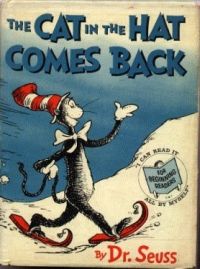 The Cat In The Hat was published by Random House. However
because of it's success, an independent publishing company was formed, called Beginner
Books. Theodor Seuss Geisel, aka Dr. Seuss, was the president and editor.
The Cat In The Hat was published by Random House. However
because of it's success, an independent publishing company was formed, called Beginner
Books. Theodor Seuss Geisel, aka Dr. Seuss, was the president and editor.
Beginner Books was chartered as a series of books oriented toward various stages of early reading development. The second book in the series was nearly as popular, The Cat In The Hat, published in 1958.
Springing from this series of beginning readers were such standards as A Fly Went By (1958), Put Me In The Zoo (1958), Green Eggs and Ham (1960), Go, Dog. Go! (1961), Hop On Pop (1963), and Fox in Socks (1965), each a monument in the picturebook industry, and also significant in the historical development of early readers. All are still in print and remain very popular over forty years after their initial publication.
Creators in the Beginner Book series were such luminaries as Jan & Stan Berenstain, P. D. Eastman, Roy McKie, and Helen Palmer (Mr. Geisel's wife). The Beginner Books dominated the children's picturebook market of the 1960's, and still plays a significant role today within the phases of students' reading development.
Before The Cat
Prior to the publication of his first children's book in 1937, And To Think That I Saw It On Mulberry Street (Vanguard Press, 1937)), Theodor Seuss Geisel was a prominent and successful humorist illustrator for such magazines as Judge and Life.
By the time of The Cat In The Hat's publication, Dr. Seuss was a very successful children's book illustrator, having published twelve children's books, three of which had won Caldecott Honor awards. Actually, prior to the publication of The Cat In The Hat, one could easily say that Dr. Seuss had already had two successful illustration careers, one as a humorist and one as a picturebook creator.
John Hersey and Dr. Seuss
Mr. Geisel created The Cat In The Hat in reaction to a Life Magazine article by Pulitzer Prize winning author John Hersey, published in the May 24, 1954 issue, titled "Why Do Students Bog Down On First R? A LOCAL COMMITTEE SHEDS LIGHT ON A NATIONAL PROBLEM: READING." In the article, Hersey was critical of the then current state of school primers,
In the classroom boys and girls are confronted with books that have insipid illustrations depicting the slicked-up lives of other children. [Existing primers] feature abnormally courteous, unnaturally clean boys and girls." "In bookstores, anyone can buy brighter, livelier books featuring strange and wonderful animals and children who behave naturally, i.e., sometimes misbehave. Given incentive from school boards, publishers could do as well with primers.
Hersey's arguments were enumerated in some ten pages of Life Magazine, which was the leading periodical of its time. After detailing many issues contributing to the dilemma with student's reading, toward the end of the article, Hersey redundantly asked:
Why should [school primers] not have pictures that widen rather than narrow the associative richness the children give to the words they illustrate - drawings like those of the wonderfully imaginative geniuses among children's illustrators, Tenniel, Howard Pyle, "Dr. Seuss," Walt Disney?
Geisel responded to this "challenge" by rigidly limiting himself to a small set of words from an elementary school vocabulary list, then crafted a story based upon two randomly selected words - cat and hat. The results of this personal challenge are nothing short of amazing!
After The Cat
Successful before the publication of the The Cat In The Hat, after it's publication, Dr. Seuss became an 'overnight' national phenomenon.
After the publication of The Cat In The Hat, numerous feature articles were published in Life, Look and other prominent periodicals. The book's characters, along with other Seuss creations, were extended into toys and other products, occurring long before co-merchandising and line extensions became commonplace for children's character marketing.
Values for the First Fifty Beginner Books
The values in the following table are for first edition books, with dust jackets. In most cases, the first edition book cannot be properly identified without the dust jacket.
| Series | Year | Title | VG+ | Illustrator | Author |
|---|---|---|---|---|---|
| B-01 | 1957 | The Cat In The Hat | $4,000 | Dr. Seuss | Dr. Seuss |
| B-02 | 1958 | Cat In The Hat Comes Back | $300 | Dr. Seuss | Dr. Seuss |
| B-03 | 1958 | A Fly Went By | $260 | Fritz Siebel | Mike McClintock |
| B-04 | 1958 | The Big Jump & Other Stories | $260 | Katherine Evans | Benjamin Elkin |
| B-05 | 1958 | A Big Ball Of String | $260 | Marion Holland | Marion Holland |
| B-06 | 1958 | Sam And The Firefly | $260 | P.D. Eastman | P. D. Eastman |
| B-07 | 1959 | You Will Go To The Moon | $150 | Lee J. Ames | Mae & Ira Freeman |
| B-08 | 1959 | Cowboy Andy | $180 | E. Raymond Kinstler | Edna W. Chandler |
| B-09 | 1959 | The Whales Go By | $180 | Paul Galdone | Fred Phleger |
| B-10 | 1959 | Stop That Ball! | $300 | Fritz Siebel | Mike McClintock |
| B-11 | 1959 | Bennett Cerf's Book Of Laughs | $180 | Carl Rose | Bennett Cerf |
| B-12 | 1959 | Ann Can Fly | $180 | Robert Lopshire | Fred Phleger |
| B-13 | 1960 | One Fish, Two Fish, Red Fish, Blue Fish | $640 | Dr. Seuss | Dr. Seuss |
| B-14 | 1960 | The King's Wish & Other Stories | $120 | Leonard Shortall | Benjamin Elkin |
| B-15 | 1960 | Bennett Cerf's Book Of Riddles | $180 | Roy McKie | Bennett Cerf |
| B-16 | 1960 | Green Eggs And Ham | $4,800 | Dr. Seuss | Dr. Seuss |
| B-17 | 1960 | Put Me In The Zoo | $600 | Robert Lopshire | Robert Lopshire |
| B-18 | 1960 | Are You My Mother? | $600 | P.D. Eastman | P. D. Eastman |
| B-19 | 1961 | Ten Apples Up On Top! | $900 | Roy McKie | Theo LeSieg (Seuss) |
| B-20 | 1961 | Go, Dog. Go! | $600 | P.D. Eastman | P. D. Eastman |
| B-21 | 1961 | Little Black, A Pony | $240 | James Schucker | Robert Farley |
| B-22 | 1961 | Look Out For Pirates | $150 | H. B. (Herman) Vestal | Iris Vinton |
| B-23 | 1961 | Fish Out Of Water | $360 | P.D. Eastman | Helen Palmer |
| B-24 | 1961 | Bennett Cerf's More Riddles | $140 | Roy McKie | Bennett Cerf |
| B-25 | 1962 | Robert The Rose Horse | $120 | P.D. Eastman | Joan Heilbroner |
| B-26 | 1962 | I Was Kissed By A Seal At The Zoo | $120 | Lynn (photos) Fayman | Helen Palmer |
| B-27 | 1962 | Snow | $140 | Roy McKie | P. D. Eastman |
| B-28 | 1962 | The Big Honey Hunt | $300 | Stan & Jan Berenstain | Same |
| B-29 | 1963 | Hop On Pop | $600 | Dr. Seuss | Dr. Seuss |
| B-30 | 1963 | Dr. Seuss's ABC | $600 | Dr. Seuss | Dr. Seuss |
| B-31 | 1963 | Do You Know What I'm Going To Do Next Saturday? | $120 | Lynn Fayman (photos) | Helen Palmer |
| B-32 | 1963 | Summer | $140 | Roy McKie | Alice Low |
| B-33 | 1963 | Little Black Goes To The Circus | $120 | James Schucker | Walter Farley |
| B-34 | 1964 | Bennett Cerf's Book Of Animal Riddles | $120 | Roy McKie | Bennett Cerf |
| B-35 | 1964 | Why I Built The Boogle House | $100 | Lynn Fayman (photos) | Helen Palmer |
| B-36 | 1964 | The Bike Lesson | $240 | Stan & Jan Berenstain | Same |
| B-37 | 1964 | How To Make Flibbers | $160 | Robert Lopshire | Robert Lopshire |
| B-38 | 1965 | Fox In Socks | $300 | Dr. Seuss | Dr. Seuss |
| B-39 | 1965 | The King, The Mice And The Cheese | $120 | Eric Gurney | Nancy Gurney |
| B-40 | 1965 | I Wish That I Had Duck Feet | $600 | B. Tobey | Theo LeSieg (Seuss) |
| B-41 | 1966 | The Bears' Picnic | $200 | Stan & Jan Berenstain | Same |
| B-42 | 1966 | Don And Donna Go To Bat | $160 | B. Tobey | Al Perkins |
| B-43 | 1966 | You Will Live Under The Sea | $100 | Ward Brackett | Fred Phleger |
| B-44 | 1966 | Come Over To My House | $320 | Richard Erdoes | Theo LeSieg (Seuss) |
| B-45 | 1967 | Babar Loses His Crown | $140 | Laurent de Brunhoff | Laurent de Brunhoff |
| B-46 | 1967 | The Bear Scouts | $180 | Stan & Jan Berenstain | Same |
| B-47 | 1967 | The Digging-Est Dog | $100 | Eric Gurney | Al Perkins |
| B-48 | 1967 | Travels Of Doctor Dolittle | $100 | Philip Wende | Al Perkins (adapted) |
| B-49 | 1968 | Doctor Dolittle And The Pirates | $100 | Philip Wende | Al Perkins (adapted) |
| B-50 | 1968 | Off To The Races | $100 | Leo Summers | Fred Phleger |
Collecting First Edition Beginner Books
First printings of the each of Beginner Books published from 1957-to-1973 should be considered by children's book collectors. Many collectors are on the lookout for the Dr. Seuss books, however there has not been as keen an interest in the non-Seuss Beginner Books. The non-Seuss books are relatively inexpensive in the market place, however locating first printings is difficult. Part of the difficulty is due to the uncertainty in the industry in identifying true first printings of the early Beginner Books. To help rectify this issue we published first edition identification for the first fifty-five Beginner Books on our website.
In 2001 Publisher's Weekly created their lists of the All-Time Bestselling Children's Books, for both hardcover and paperback books. We consider copies sold one of the key factors in the collectibility of a children's book (when the initial printing is low relative to the eventual copies sold). Twenty of the Beginner Books made the list, with eleven in the All-Time Bestselling top 50. Several of the Beginner Books are from the 'Bright and Early' sub-series which was started in 1967.
Not surprisingly, Dr. Seuss books dominate the list, although all of the first printings are desirable. Some of the non-Seuss first printings are very difficult to come by, especially Are You My Mother?, Go, Dog, Go! and Put Me In The Zoo, each of which have out sold many of the Dr. Seuss books. You should also be on the lookout for first printings of a A Fly Went By and Book of Riddles.

The first twelve Beginner Books were published between 1957-to-1959 and should be on your 'watch for' list. First editions are easily identifiable, as all but Cat In The Hat state 'First Printing' on the copyright page. We've documented first edition identification points for Cat In The Hat on our blog.
Another key book in the series is Helen Palmer's A Fish Out of Water, illustrated by P.D. Eastman. Palmer was Geisel's wife, and wrote several of the early Beginner Books. However we think Dr.Seuss should be given co-authorship as we wrote in an article A Story Of Two Fish: Dr. Seuss Out Of Water, comparing A Fish Out Of Water to Seuss's Gustav The Goldfish.
© Stan Zielinski
A serious collector having fun with fun books.
Attribution
© Stan Zielinski. Author of the Children's Picturebook Price Guide

This
work is licensed under a
Creative Commons Attribution-NonCommercial-ShareAlike 3.0 License.
In layman's terms, that means you may excerpt, share, and use this material as long as you credit Stan as the author and provide a link back to the specific content page. And do not sell it or use it for commercial purposes.
The information offered on 1stedition.net and the blog is offered free of charge. Any uses, references, and or copies of this website in whole or in part must include the bibliographic citation, including author attribution, article title, date (in the case of blog posts) and link to the URL 1stedition.net. Include the copyright notice.
In no event shall a Creative Commons Attribution License or Stan Zielinski be liable for any damages of any kind arising out of or in connection with the use of the articles on this website. This website is provided "as is" without warranty of any kind, either expressed or implied. Descriptions of, or references to, persons, websites, or businesses does not imply endorsement of that person, website or business.