Identifying, and Valuing First Edition Dr Seuss Books
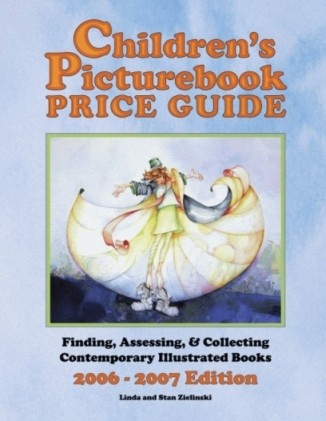 The following table is an excerpt from our book the
Children's Picturebook Price Guide. The estimated values are for first
edition books, with dust jackets.
The following table is an excerpt from our book the
Children's Picturebook Price Guide. The estimated values are for first
edition books, with dust jackets.
Any person seriously in the market for Dr. Seuss books should also own a copy of First Editions of Dr. Seuss Books (2002), by Helen Younger, Marc Younger, and Dan Hirsch. Within the hobby, this book is considered the definitive guide to correctly identifying Dr. Seuss first edition books, providing detailed information on each book, along with full color examples of books and dust jackets. Given the cost of making a mistake with Dr. Seuss first editions, the Younger/Hirsch guide is an invaluable resource.
 We had been collecting Dr. Seuss first edition books
for many years prior to the publication of the Younger/Hirsch book, and in the process
had compiled our own list of points to help us identify many of the older first
edition books. This list is included in the
Children's Picturebook Price Guide
We had been collecting Dr. Seuss first edition books
for many years prior to the publication of the Younger/Hirsch book, and in the process
had compiled our own list of points to help us identify many of the older first
edition books. This list is included in the
Children's Picturebook Price Guide
In all cases, we either own, or have had in our possession, the first edition book with the identifying points listed. The information differs in several cases from that presented in Younger/Hirsch, since it is a result of our own research.
We have been posting identification points (points of issue) for Dr. Seuss first edition books on the Identifying Dr. Seuss First Edition Books. In the table below, the book's title is a link to the identification points for the first edition book.
Values for Dr. Seuss First Edition Books
The values are for first edition books, with dust jackets.
| Year | Book Title | VG- | VG | VG+ |
|---|---|---|---|---|
| 1937 | And To Think That I Saw It On Mulberry Street | $8,000 | $9,000 | $12,000 |
| 1938 | The 500 Hats Of Bartholomew Cubbins | $6,000 | $7,500 | $9,000 |
| 1939 | The Seven Lady Godivas | $500 | $750 | $900 |
| 1939 | The King's Stilts | $6,000 | $7,500 | $9,000 |
| 1940 | Horton Hatches The Egg | $6,000 | $7,500 | $9,000 |
| 1947 | McElligot's Pool | $4,000 | $5,000 | $6,000 |
| 1948 | Thidwick: The Big-Hearted Moose | $3,000 | $3,750 | $4,500 |
| 1949 | Bartholomew And The Oobleck | $2,000 | $2,500 | $3,000 |
| 1950 | If I Ran The Zoo | $1,600 | $2,000 | $2,400 |
| 1953 | Scrambled Eggs Super | $1,200 | $1,400 | $1,600 |
| 1954 | Horton Hears A Who | $1,600 | $2,000 | $2,800 |
| 1955 | On Beyond Zebra | $800 | $1,000 | $1,200 |
| 1956 | If I Ran The Circus | $800 | $1,000 | $1,200 |
| 1957 | The Cat In The Hat | $2,400 | $3,200 | $4,000 |
| 1957 | How The Grinch Stole Christmas | $1,200 | $1,600 | $2,000 |
| 1958 | Cat In The Hat Comes Back | $180 | $240 | $300 |
| 1958 | Yertle The Turtle And Other Stories | $180 | $240 | $300 |
| 1959 | Happy Birthday To You | $160 | $200 | $260 |
| 1960 | One Fish, Two Fish, Red Fish, Blue Fish | $380 | $520 | $640 |
| 1960 | Green Eggs And Ham | $2,400 | $3,600 | $4,800 |
| 1961 | The Sneetches And Other Stories | $150 | $225 | $300 |
| 1962 | Dr. Seuss's Sleep Book | $150 | $225 | $300 |
| 1963 | Hop On Pop | $320 | $420 | $520 |
| 1963 | Dr. Seuss's ABC | $320 | $420 | $520 |
| 1965 | Fox In Socks | $150 | $225 | $300 |
| 1965 | I Had Trouble In Getting To Solla Sollew | $150 | $225 | $300 |
| 1967 | The Cat In The Hat Song Book | $90 | $120 | $150 |
| 1968 | Foot Book | $800 | $1,200 | $1,600 |
Identifying Dr. Seuss First Edition Books Without Dust Jackets
The conventional wisdom among booksellers is first edition Dr. Seuss books cannot be identified without the dust jacket. This used to be true. With the recent discovery of some salient information, today, most of the large format Dr. Seuss books can be identified as first printings without the dust jacket.
There are a couple of cases where the first printing book is indistinguishable from the book used in the 2nd and 3rd printing. In these cases, the book remained unchanged but the dust jacket was changed. Even so, these books still have collectibility (desirability) and value.
To help clarify, from the ABAA’s glossary:
Edition & Printing:
Edition includes the copies of a book or other printed material which originate from the same plates or setting of type. If 500 copies of a book are printed on Oct. 5 and 300 copies are printed from the same substantially unchanged plates on Dec. 10, all 800 copies are part of the same edition.
Printing: the copies of a book or other printed material which originate from the same press run or from the same plates or setting of type at one time.
In the example given for "Edition" above, the 500 copies would be the first printing and the 300 copies comprise the second printing.
First Edition:
All of the copies printed from the first setting of type; can include multiple printings if all are from the same setting of type. When book collectors use the term first edition, they are usually referring to the first printing and if there are different states or issues, the earliest of those.
In all of the Dr. Seuss books presented, the first edition book can be identified without the dust jackets. In nearly all cases, the book is also the first edition/first printing. In a couple of cases, the book is the first edition/’first or early’ printing.
We describe ‘Availability’ for each of the books. Most of the first edition books are difficult to find in the market. ‘Very difficult’ means one or no copies are usually available from the internet bookselling sites (ABE, Alibris, or Bookfinder). ‘Extremely difficult’ means a copy is not usually on the market, however might surface once or twice per year.
[Note: Where applicable, below, the book's title links to the identification points for the first edition book with dust jacket.]
It’s difficult to price first edition books without dust jackets. A first edition Mulberry Street with dust jacket might sell for $8000 in Very Good condition. The first edition book might sell in the $300-$600 range, so about 1/20th the value of the first edition book with dust jacket.
The Cat In The Hat first edition book with dust jacket would have a market value of $4000 or so in Very Good condition. The first edition book might sell for $50 or so, since it is not too difficult to find.
Since the Dr. Seuss first edition books with dust jacket are too expensive for many
children's book collectors, they might consider the first edition book without dust
jacket as an alternative.
And To Think That I Saw It On Mulberry Street 1937
 Title
page with ‘1937,’ Vanguard Press, and copyright page with no additional
printings listed. Marco’s shorts are white on the front cover; on later printings
Marco had blue shorts.
Title
page with ‘1937,’ Vanguard Press, and copyright page with no additional
printings listed. Marco’s shorts are white on the front cover; on later printings
Marco had blue shorts.
Availability: ‘White pants’ books are extremely difficult to find.
The 500 Hats Of Bartholomew Cubbins 1938
The front endpapers progress from large hats to small hats; the rear endpapers progress from small hats to large hats. On later printings the progression was reversed.
Availability: ‘Large-to-small hat’ books are extremely difficult to find.
The King's Stilts 1939
 Front
cover with the yellow text ‘The King’s Stilts by Dr. Seuss’ on
a red background covering nearly the entire area. On later printings, the title
was reduced in size, with red text on a yellow cloth background.
Front
cover with the yellow text ‘The King’s Stilts by Dr. Seuss’ on
a red background covering nearly the entire area. On later printings, the title
was reduced in size, with red text on a yellow cloth background.
Availability: ‘Large logo’ books are very difficult to find.
Horton Hatches The Egg 1940

States ‘First Printing’ on the copyright page.
Availability: ‘First Printing’ books are extremely difficult to find.
McElligot’s Pool 1947
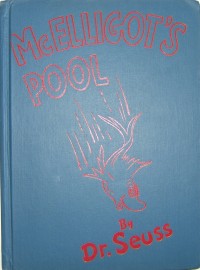 Front
cover has fish with mouth open.
Front
cover has fish with mouth open.
Availability: ‘Open mouth’ books are very difficult to find.
Thidwick: The Big-Hearted Moose 1948
 The
first edition boards are red. The book with red boards was used with the first printing
dust jacket (with ‘starburst’) and the second printing dust jacket (sans
‘starburst’, ‘200/200’ on front flap).
The
first edition boards are red. The book with red boards was used with the first printing
dust jacket (with ‘starburst’) and the second printing dust jacket (sans
‘starburst’, ‘200/200’ on front flap).
Availability: Red boards books are difficult to find.
Bartholomew And The Oobleck 1949
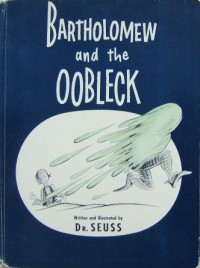 The
first printing book has blue boards. Later printings were changed to red boards.
The
first printing book has blue boards. Later printings were changed to red boards.
Availability: Blue boards books are difficult to find.
If I Ran The Zoo 1950
 Copyright
page with seven lines only, omitting the line “BASED ON MATERIAL WHICH ORIGINALLY
APPEARED IN REDBOOK MAGAZINE.” Later printings have eight lines, including
the Redbook line.
Copyright
page with seven lines only, omitting the line “BASED ON MATERIAL WHICH ORIGINALLY
APPEARED IN REDBOOK MAGAZINE.” Later printings have eight lines, including
the Redbook line.
Availability: ‘No Redbook’ boards books are extremely difficult to find.
Horton Hears A Who 1954
 Horton
has full ear on back cover and the list of other Seuss titles on the recto of the
back free endpaper. Second printings also have Horton with full ear on back cover
and Seuss title list on the copyright page.
Horton
has full ear on back cover and the list of other Seuss titles on the recto of the
back free endpaper. Second printings also have Horton with full ear on back cover
and Seuss title list on the copyright page.
Availability: ‘Full ear/Rear titles page’ boards books are extremely
difficult to find.
Availability: ‘Full ear/Copyright titles page’ books are very difficult
to find.
If I Ran The Circus 1956
 The
first printing book has pink boards. Later printings were changed to red & yellow
boards.
The
first printing book has pink boards. Later printings were changed to red & yellow
boards.
Availability: ‘Pink boards’ books are not so difficult to find.
The Cat In The Hat 1957
Matte boards with single binding signature. Later printings have glossy boards with three binding signatures.
The ‘matte cover with single signature’ book can be found with the 2nd printing dust jacket (no price on flap) and 3rd printing dust jackets (‘195/195’ on front flap).
Availability: ‘Single signature’ books are difficult to find.
How The Grinch Stole Christmas 1957
 Back
cover with full page advertisement for The Cat In The Hat offered for sale for $2.00.
Back
cover with full page advertisement for The Cat In The Hat offered for sale for $2.00.
This book was used on 2nd printing dust jackets (295/295 front flap) and 3rd printing dust jackets (295/295 and 16 titles listed).
Availability: ‘Back Ad $2.00’ books are not so difficult to find.
Cat In The Hat Comes Back 1958
Copyright
page states ‘First Printing.” Also, the snowball to the left of the
Cat's tail is only on the first edition book.
Availability: ‘First Printing’ books are not so difficult to find.
Happy Birthday To You 1959
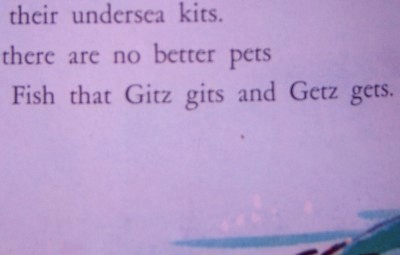 The
first printing book has a printing error on page 34 (page beginning with “Today
is your birthday”), with six white spots that do not appear in later printings.
The
first printing book has a printing error on page 34 (page beginning with “Today
is your birthday”), with six white spots that do not appear in later printings.
Availability: ‘White spots’ books are not so difficult to find.
First Edition, First Printing
It is a complicated subject, the book collecting definition of 'first edition' being ‘first edition, first printing.’
As an example, the "conventional wisdom" first edition The Cat In The Hat, with the ‘200/200’ on the front flap, is considered the first printing, while the '200/200' was in actuality used in numerous printings.
"Huh?", you ask. Let me explain.
The Cat In The Hat was first published in March of 1957. The sales far exceeded initial expectations. The ‘200/200’ dust jacket was used on the book into early 1958, and perhaps mid-1958. The first instance I can find of the book’s price reduction to ‘195/195’ is in the October, 1958 edition of The Horn Book Magazine (pg. 325), where Random House advertises the first six Beginner Books for $1.95.
It is illogical to believe the initial printing of The Cat In The Hat in March, 1957 was sufficient to supply books for nearly a year of sales, through January or March of 1958. And especially in light of sales being higher then initially expected. Therefore the logical conclusion is there were multiple printings of the ‘200/200’ Cat In The Hat through the course of 1957.
Currently the book collecting community cannot distinguish the initial ‘200/200’ printing from each of the other ‘200/200’ printings, yet we still consider all as ‘first edition/first printing’.
The first edition ‘200/200’ Cat In The Hat routinely sells for $3000 in today’s market.
© Stan Zielinski
A serious collector having fun with fun books.
Attribution
© Stan Zielinski. Author of the Children's Picturebook Price Guide

This
work is licensed under a
Creative Commons Attribution-NonCommercial-ShareAlike 3.0 License.
In layman's terms, that means you may excerpt, share, and use this material as long as you credit Stan as the author and provide a link back to the specific content page. And do not sell it or use it for commercial purposes.
The information offered on 1stedition.net and the blog is offered free of charge. Any uses, references, and or copies of this website in whole or in part must include the bibliographic citation, including author attribution, article title, date (in the case of blog posts) and link to the URL 1stedition.net. Include the copyright notice.
In no event shall a Creative Commons Attribution License or Stan Zielinski be liable for any damages of any kind arising out of or in connection with the use of the articles on this website. This website is provided "as is" without warranty of any kind, either expressed or implied. Descriptions of, or references to, persons, websites, or businesses does not imply endorsement of that person, website or business.